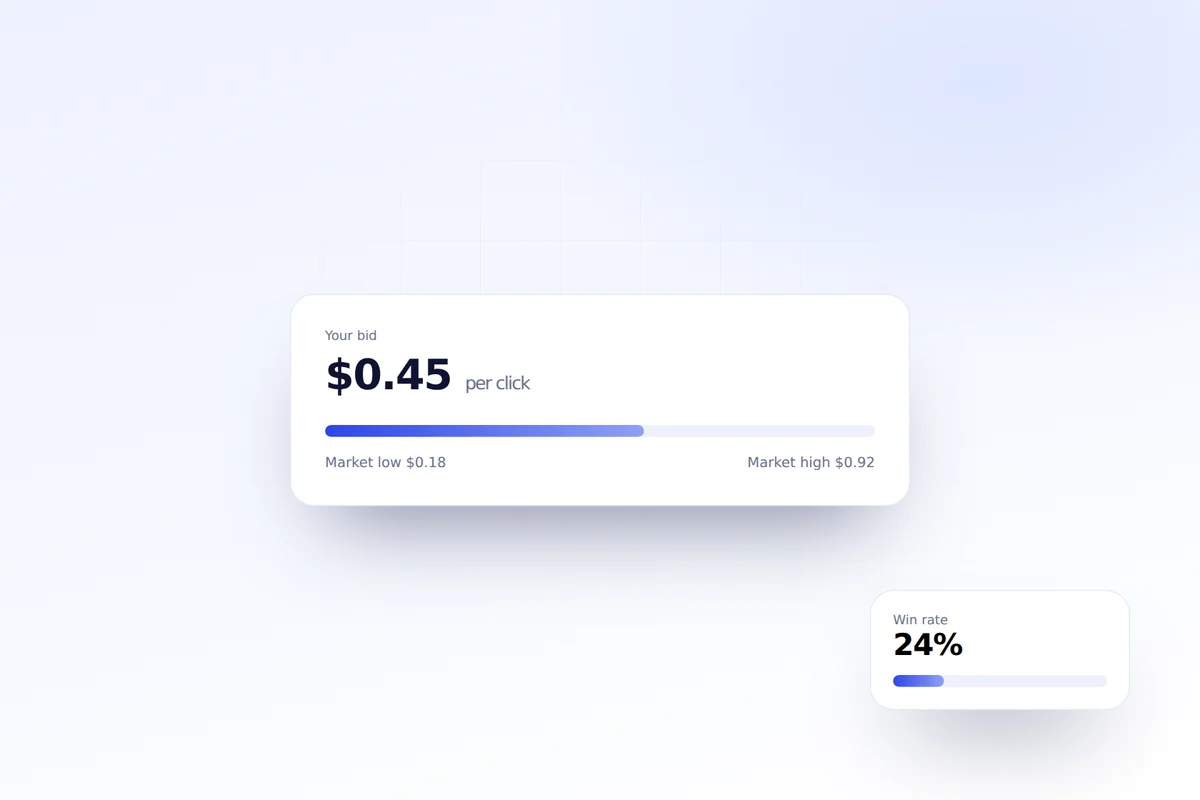
You have a new market, no history, and a box asking what you are willing to pay. Bid too low and nothing delivers. Bid too high and you learn an expensive lesson. Here is how we set a first bid when there is nothing to copy from.
Why the first bid is hard
A bid is not a price list. It is the most you are willing to pay in an auction you cannot see. Every other buyer is deciding the same thing at the same moment, and the winner pays enough to beat the next bid, not the full amount they offered.
So the first bid is really a question: how much is this person worth to me, before I know anything about them?
Start from what a result is worth
Work backwards from the sale, not forwards from the market.
- Take your average order value and your margin. If an order is $80 and you keep $24, that is your ceiling for one sale.
- Decide what share of that you are willing to pay to acquire it. Most brands land between a third and a half when they are growing.
- Divide by a realistic conversion rate. If 1 in 60 clicks buys, and you will pay $10 for a sale, your click is worth about $0.16.
That number is your anchor. The market may not let you buy at it, but now you know when to stop.
A starting range by format
For a new US campaign, these are the ranges we usually open with. They are starting points, not promises.
| Format | Model | Opening bid |
|---|---|---|
| Display | Per thousand views | $1.20 – $2.50 |
| Display | Per click | $0.25 – $0.60 |
| Native | Per click | $0.35 – $0.80 |
| Video (outstream) | Per thousand views | $6 – $12 |
| Connected TV | Per thousand views | $18 – $32 |
If your anchor from the last section is far below the opening range, the problem is not the bid. It is either the margin, the landing page, or the market.
What to do in week one
- Day 1 to 2. Launch at the middle of the range with a small daily budget. Do not touch anything. You are buying information, not results.
- Day 3. Look at delivery, not conversions. If you are spending less than half your budget, the bid is too low for this market. Raise it 15 per cent.
- Day 4 to 5. Open the placement report. Block anything that spent real money and returned nothing.
- Day 6 to 7. Now look at cost per result. Compare it to your anchor, not to someone else’s benchmark.
One change at a time. Two changes on the same day tell you nothing about which one worked.
When to raise, and when to walk away
Raise the bid when delivery is capped, the placements that do deliver are working, and your cost per result still sits under your anchor. You are buying more of something that already pays.
Lower the bid when you are spending the full budget but the cost per result is above your anchor and the placement list looks thin.
Stop when you have spent enough to see fifty to a hundred results and the maths still does not work. The market is telling you something, and another ten per cent on the bid will not change it.
The most common mistake is raising the budget when delivery is weak. If the bid is too low, a bigger budget just means a bigger number you cannot spend.
A short checklist
- Know what a result is worth before you open the campaign.
- Open at the middle of the range, not the bottom.
- Give it 48 hours before touching anything.
- Judge delivery first, cost per result second.
- Block weak placements weekly.
- Raise the bid before the budget.